SideLines, April 2008
There has been some serious laughing-but-not-laughing about New Zealand science funding in the news recently ("NZ research assistance 'laughable', Weekend Herald, March 8th 2008).
Part of the problem is a lack of business spending on research.
What does this mean when so much of New Zealand business is driven by international companies? Presumably, they do a lot of their research in other countries.
New Zealand has had some success with agricultural-industry groups pooling their resources to carry out research that is valuable for all members.
Is there any way that disparate small companies can pool their resources to support the pre-proprietary stages of research? What topics would be relevant to diverse small companies in a small and relatively-isolated country?
Social research on employment-related issues? Logistical research on transport systems? Legal research on doing business across the ditch? Research on the risks of not doing research? (Try selling sunhats on a rainy day).
A good starting point might be to create a science-fashion magazine with a title like: 'Science for Every Occasion' (SEO, now recruiting, wanted: science writers with flair).
It might be laughable, but textile science is a big business, and the Wearable Art contest in New Zealand is a joke that seems to never wear thin. I have no doubt that there is a lot of science behind the art.
You can laugh, but some of those hats might be useful on Mars.
About the Research Cooperative: For free membership and to publish or modify Notices, please register here: Registration/Log-in
Comments can be posted in our Viewpoints forum (see menu above).
Friday, April 25, 2008

Thursday, March 06, 2008
Higher education going down (Japan)
SideLines, March 2008
In the Japan Times of 28th Feb., 2008, W. Hollingworth introduces the conclusions of Roger Goodman, from Oxford University, on the future of higher education in Japan.
The falling birthrate in this country, and the limited movement older-age students into universities, are leading to "an implosion of a type not seen before". "There is little evidence that the vast-majority of the lower-level four universities will be able to rise to meet the demographic challenges that currently face them".
Goodman suggests that struggling Japanese universities should look to alternative sources of income by undertaking more research projects and raising endowments. Japanese universities also struggle to attract foreign students, so Goodman also suggests employing more foreign staff, and conducting more courses in English.
His work, "‘Education in the Aged Society: The Demographic Challenge to Japanese Education’, will be published soon (March, 2008) in Florian Coulmas, Harald Conrad, Annette Schad and Gabriele Vogt (eds)., The Demographic Challenge: A Handbook about Japan, Leiden: Brill Academic Publishers.
Comment: Historically, it has been quite difficult for Japanese to return to Japan and find work after long periods of study and work abroad. Perhaps a more open employment system will also help them, as well as helping universities to survive in Japan.
In the Japan Times of 28th Feb., 2008, W. Hollingworth introduces the conclusions of Roger Goodman, from Oxford University, on the future of higher education in Japan.
The falling birthrate in this country, and the limited movement older-age students into universities, are leading to "an implosion of a type not seen before". "There is little evidence that the vast-majority of the lower-level four universities will be able to rise to meet the demographic challenges that currently face them".
Goodman suggests that struggling Japanese universities should look to alternative sources of income by undertaking more research projects and raising endowments. Japanese universities also struggle to attract foreign students, so Goodman also suggests employing more foreign staff, and conducting more courses in English.
His work, "‘Education in the Aged Society: The Demographic Challenge to Japanese Education’, will be published soon (March, 2008) in Florian Coulmas, Harald Conrad, Annette Schad and Gabriele Vogt (eds)., The Demographic Challenge: A Handbook about Japan, Leiden: Brill Academic Publishers.
Comment: Historically, it has been quite difficult for Japanese to return to Japan and find work after long periods of study and work abroad. Perhaps a more open employment system will also help them, as well as helping universities to survive in Japan.
Sunday, February 03, 2008
Found a great bookshop
SideLines, February 2008
Today I went for a Sunday walk in Kyoto City with my family. We went from one temple or shrine to the next to enjoy the lunar New Year festivities.
On one street corner we found some narrow stairs leading up to a second-hand books shop called Greenebooks.
This shop buys and sells books in any language except Japanese. The very eclectic range was mainly English-language. A New Year sale was in progress (50% price reductions!), and the books were mostly very good. The shop is close to Kyoto University, which has many foreign visitors and students.
I was happy to discover and purchase the following (no relation): J. R. Matthews et al. (1996) Successful scientific writing: A step-by-step guide for the biological and medical sciences. Cambridge University Press: Cambridge. 181 pp.
After a quick browse, I can recommend this book highly.
I particularly enjoy a section on 'devil pairs' (pp. 131-134). These are pairs of similar or related words that many writers get confused by, and choose wrongly.
After returning home, we scattered beans to drive out evil spirits from our house ('Setsubun' is an old Japanese custom on the last night of Winter). Maybe we also gave some 'devil pairs' a fright.
For extra effect, we tied a smelly, grilled fish-head to some thorny holly leaves to the frame above our door, outside. The leaves were kindly provided by our local supermarket when we bought fish yesterday.
Who needs biotechnology when we can use magic like this?!
Today I went for a Sunday walk in Kyoto City with my family. We went from one temple or shrine to the next to enjoy the lunar New Year festivities.
On one street corner we found some narrow stairs leading up to a second-hand books shop called Greenebooks.
This shop buys and sells books in any language except Japanese. The very eclectic range was mainly English-language. A New Year sale was in progress (50% price reductions!), and the books were mostly very good. The shop is close to Kyoto University, which has many foreign visitors and students.
I was happy to discover and purchase the following (no relation): J. R. Matthews et al. (1996) Successful scientific writing: A step-by-step guide for the biological and medical sciences. Cambridge University Press: Cambridge. 181 pp.
After a quick browse, I can recommend this book highly.
I particularly enjoy a section on 'devil pairs' (pp. 131-134). These are pairs of similar or related words that many writers get confused by, and choose wrongly.
After returning home, we scattered beans to drive out evil spirits from our house ('Setsubun' is an old Japanese custom on the last night of Winter). Maybe we also gave some 'devil pairs' a fright.
For extra effect, we tied a smelly, grilled fish-head to some thorny holly leaves to the frame above our door, outside. The leaves were kindly provided by our local supermarket when we bought fish yesterday.
Who needs biotechnology when we can use magic like this?!
Higher Education and Newspapers
SideLines, January 2008
In many countries, major newspapers may publish special supplements on science or higher education, and these may also appear in newspaper websites.
See for example:
The Australian
The Sydney Morning Herald, and its online Classroom, and
New Zealand Herald Science
Such publications would be a good target for promoting the Research Cooperative website for research editors, translators and writers.
In many countries, major newspapers may publish special supplements on science or higher education, and these may also appear in newspaper websites.
See for example:
The Australian
The Sydney Morning Herald, and its online Classroom, and
New Zealand Herald Science
Such publications would be a good target for promoting the Research Cooperative website for research editors, translators and writers.
Saturday, December 22, 2007
Sunday, December 02, 2007
Cyber University
SideLines, Nov.-December 2007
Y. Kageyama (Japan Times 1. Dec 2007) reports that Cyber University is the only university in Japan to offer all its courses on the internet, and that it has recently started offering classes on mobile phones.
For mobile viewing, the handset screen can only offer Power Point images and sound. So it will be more of an adjunct to full internet access.
Online studies are of course second-best to direct interactions with teachers and other students in live classes - but potentially can reach many people who would otherwise have no chance at all to study.
Are students going to become great writers if they try to send in essays written on mobile phone handsets?!
About the Research Cooperative: For free membership and to publish or modify Notices, please register here: Registration/Log-in
Comments can be posted in our Viewpoints forum (see menu above).
Y. Kageyama (Japan Times 1. Dec 2007) reports that Cyber University is the only university in Japan to offer all its courses on the internet, and that it has recently started offering classes on mobile phones.
For mobile viewing, the handset screen can only offer Power Point images and sound. So it will be more of an adjunct to full internet access.
Online studies are of course second-best to direct interactions with teachers and other students in live classes - but potentially can reach many people who would otherwise have no chance at all to study.
Are students going to become great writers if they try to send in essays written on mobile phone handsets?!
About the Research Cooperative: For free membership and to publish or modify Notices, please register here: Registration/Log-in
Comments can be posted in our Viewpoints forum (see menu above).
Wednesday, October 17, 2007
PhD Jobseeker Logo
SideLInes October, 2007
K. Sugimoto in the Asahi Newspaper (7th August, 2007) reports that The Japan Society of Applied Physics has created a "Career Explorer" logo for PhD graduates who are looking for jobs. At academic conferences, the graduates are encouraged to use the logo on their posters, or in their talks, because such conferences are an ideal venue to advertise the need for a job - a captive audience is provided.
The Society says that PhD graduates should not be shy about advertising their qualifications.
The Research Cooperative believes that graduates should also use every opportunity to improve their writing and presentation skills, with their own research results, and also by helping others through the reading, editing or translation of research papers - there is always work to be done.
K. Sugimoto in the Asahi Newspaper (7th August, 2007) reports that The Japan Society of Applied Physics has created a "Career Explorer" logo for PhD graduates who are looking for jobs. At academic conferences, the graduates are encouraged to use the logo on their posters, or in their talks, because such conferences are an ideal venue to advertise the need for a job - a captive audience is provided.
The Society says that PhD graduates should not be shy about advertising their qualifications.
The Research Cooperative believes that graduates should also use every opportunity to improve their writing and presentation skills, with their own research results, and also by helping others through the reading, editing or translation of research papers - there is always work to be done.
Thursday, September 27, 2007
United Nations University
 SideLines, August-September 2007
Hans van Ginkel, a former Rector at UNU, based in Tokyo, Japan, has written (Asahi Shimbun, 21st Sept 2007) that the UNU cannot compete as a world university with enrolled students, since many universities already take students from the around the world. Rather it should position itself at the top of an academic pyramid by focusing on post-doctoral programs in fields of expertise that are related to the agenda of the United Nations. At the same time the university has been expanding its scope by establishing centers of activity in numerous countries. Online learning has also been targeted as an area in which it should take a lead role.
Perhaps our Research Cooperative should try to ride on the coat-tails of this institutional master of the universe?
About the Research Cooperative: For free membership and to publish or modify Notices, please register here: Registration/Log-in
Comments can be posted in our Viewpoints forum (see menu above).
Saturday, July 07, 2007
Science Map
SideLines, July 2007
The Science Map (2004) is a study of publishing efforts in 'hot' research areas (1999-2004) using a bibliometric method to survey literature worldwide (Science and Technology Foresight Center, National Institute of Science and Technology). T. Kurosawa in the Asahi Shimbun (26th July 2007) summarises the main findings: Japan is ahead in high-tech fields but lagging in social sciences. Looking at the original report, no mention of language of publication is mentioned.
The entire survey is thus rendered meaningless, because the presence of Japan-based research across international, English-language publications may vary markedly according to discipline, and may have little relation to local or overall research effort, in what is one of the largest economies in the world.
Have similar surveys been conducted across Japanese-language research publications?
About the Research Cooperative: For free membership and to publish or modify Notices, please register:
Registration/Log-in
The Science Map (2004) is a study of publishing efforts in 'hot' research areas (1999-2004) using a bibliometric method to survey literature worldwide (Science and Technology Foresight Center, National Institute of Science and Technology). T. Kurosawa in the Asahi Shimbun (26th July 2007) summarises the main findings: Japan is ahead in high-tech fields but lagging in social sciences. Looking at the original report, no mention of language of publication is mentioned.
The entire survey is thus rendered meaningless, because the presence of Japan-based research across international, English-language publications may vary markedly according to discipline, and may have little relation to local or overall research effort, in what is one of the largest economies in the world.
Have similar surveys been conducted across Japanese-language research publications?
About the Research Cooperative: For free membership and to publish or modify Notices, please register:
Registration/Log-in
Sunday, June 10, 2007
Peoples Archive
SideLines, June 2007
Peoples Archive Ltd., a company based in
the United Kingdom, has taken on the challenge of interviewing and filming great "thinkers, creators, and achievers" around the world - leaders in many areas of art, science, and society generally.
Registered subscribers at Peoples Archive have more viewing options, but even non-subscribers with relatively slow internet connections can enjoy using this site.
John Maynard Smith's interview includes a segment entitled "An exercise in futility' in which he describes having to translate an English version of Virgil back into Latin, at school. The mathematical-biologist-to-be turned the 'futile' effort into an experiment in working with permutations and combinations.
Research fields currently represented by the interviews are:
Biochemistry
Biology
Chemistry
Computer Science
Immunology
Mathematics
Physics
About the Research Cooperative:
For free membership and full access to publish and modify Notices, please register:
Registration/Log-in
Peoples Archive Ltd., a company based in
the United Kingdom, has taken on the challenge of interviewing and filming great "thinkers, creators, and achievers" around the world - leaders in many areas of art, science, and society generally.
Registered subscribers at Peoples Archive have more viewing options, but even non-subscribers with relatively slow internet connections can enjoy using this site.
John Maynard Smith's interview includes a segment entitled "An exercise in futility' in which he describes having to translate an English version of Virgil back into Latin, at school. The mathematical-biologist-to-be turned the 'futile' effort into an experiment in working with permutations and combinations.
Research fields currently represented by the interviews are:
Biochemistry
Biology
Chemistry
Computer Science
Immunology
Mathematics
Physics
About the Research Cooperative:
For free membership and full access to publish and modify Notices, please register:
Registration/Log-in
Friday, May 11, 2007
Australian Education
SideLines, May 2007
Australia may be 'Down Under' but 'Higher Education' is a regular supplement in The Australian, a major newspaper. Here is a sample of article headlines from the 10 page February 14, 2007, issue:
Revamp for flawed ratings - describes an overhaul of the way Australian universities measure teaching quality.
Chancellor intervenes in VC's dispute - reports on a dispute between past and present vice-chancellors at Macquariee University.
Crooked paths to Learning - an almost anthropological analysis of how some students (in the real world) act as 'interest chasers' (rather than following unreal study and career plans that are imagined by the university employment counselling services) about which there is 'a general ignorance' among students.
Drop in federal research funding... and academic staff continue to be (substantially) outnumbered by general administrative staff.
Unable to stay the course - science, maths and language courses are imploding in Britain... the anxiety in Australia over maths and science skills is shared in Britain.
Push for increase in foreign fellows - currently the Federation of Australian Scientific and Technological Societies limits foreign nationals to just five of the 25 fellowships awarded each year.
and much more, including many higher education job advertisements.
All our forums are open for reading. For free membership and full access to write and modify Notices, please register:
Registration/Log-in
Australia may be 'Down Under' but 'Higher Education' is a regular supplement in The Australian, a major newspaper. Here is a sample of article headlines from the 10 page February 14, 2007, issue:
Revamp for flawed ratings - describes an overhaul of the way Australian universities measure teaching quality.
Chancellor intervenes in VC's dispute - reports on a dispute between past and present vice-chancellors at Macquariee University.
Crooked paths to Learning - an almost anthropological analysis of how some students (in the real world) act as 'interest chasers' (rather than following unreal study and career plans that are imagined by the university employment counselling services) about which there is 'a general ignorance' among students.
Drop in federal research funding... and academic staff continue to be (substantially) outnumbered by general administrative staff.
Unable to stay the course - science, maths and language courses are imploding in Britain... the anxiety in Australia over maths and science skills is shared in Britain.
Push for increase in foreign fellows - currently the Federation of Australian Scientific and Technological Societies limits foreign nationals to just five of the 25 fellowships awarded each year.
and much more, including many higher education job advertisements.
All our forums are open for reading. For free membership and full access to write and modify Notices, please register:
Registration/Log-in
Sunday, April 08, 2007
Science Writers
SideLines, April 2007
The (USA) National Association of Science Writers was created in 1934 by a dozen science jouralists and reporters in New York City. The aim of the organization was to improve the craft of science journalism and to promote good science reportage. The NASW incorporated in 1955, pledging itself to "foster the dissemination of accurate information regarding science through all media normally devoted to informing the public." [Wikipedia, 8th April 2007). See www.nasw.org
Recommended: A FIELD GUIDE FOR SCIENCE WRITERS
2nd edition, Oxford University Press, 2005. Deborah Blum
Mary Knudson, and Robin Marantz Henig (eds).
All our forums are open for reading. For free membership and full access to write and modify Notices, please register:
Registration/Log-in
The (USA) National Association of Science Writers was created in 1934 by a dozen science jouralists and reporters in New York City. The aim of the organization was to improve the craft of science journalism and to promote good science reportage. The NASW incorporated in 1955, pledging itself to "foster the dissemination of accurate information regarding science through all media normally devoted to informing the public." [Wikipedia, 8th April 2007). See www.nasw.org
Recommended: A FIELD GUIDE FOR SCIENCE WRITERS
2nd edition, Oxford University Press, 2005. Deborah Blum
Mary Knudson, and Robin Marantz Henig (eds).
All our forums are open for reading. For free membership and full access to write and modify Notices, please register:
Registration/Log-in
Sunday, March 25, 2007
The Oxytocin Factor
SideLines, March 2007
A recent article in the Observer reports that College (University) graduates who are really smiling and happy at graduation are likely to live longer, and have more successful marriages. The article links their happiness with the measurable surge in oxytocin, the 'bonding' hormone, that occurs when kindnesses are given and received.
In other words, close physical proximity can help people develop happy and trusting relationships. This does not bode well for writers, editors and translators who work far apart and depend on long-distance communications.
Perhaps there are optimum distances and optimum frequencies of direct personal contact for every kind of human relationship, including those strange relationships where we trust others with the results of our deepest, inner intellectual efforts.
The present Research Cooperative is designed to be international in scope, but at the same time, we should also encourage at least occasional direct contact between research writers, editors, and translators - at the local and regional levels - so that happier and more fruitful working relationships can be established.
The equivalent of a trusting handshake is not easy to accomplish by words alone.
Anyone can read our forums, but for free membership and full access, please register at http://www.researchco-op.co.nz
A recent article in the Observer reports that College (University) graduates who are really smiling and happy at graduation are likely to live longer, and have more successful marriages. The article links their happiness with the measurable surge in oxytocin, the 'bonding' hormone, that occurs when kindnesses are given and received.
In other words, close physical proximity can help people develop happy and trusting relationships. This does not bode well for writers, editors and translators who work far apart and depend on long-distance communications.
Perhaps there are optimum distances and optimum frequencies of direct personal contact for every kind of human relationship, including those strange relationships where we trust others with the results of our deepest, inner intellectual efforts.
The present Research Cooperative is designed to be international in scope, but at the same time, we should also encourage at least occasional direct contact between research writers, editors, and translators - at the local and regional levels - so that happier and more fruitful working relationships can be established.
The equivalent of a trusting handshake is not easy to accomplish by words alone.
Anyone can read our forums, but for free membership and full access, please register at http://www.researchco-op.co.nz
Saturday, February 03, 2007
Student Services in Japan
 SideLines, February 2007
The Japan Student Services Organization (JASSO) is responsible for managing student loans and scholarships as an "Indpendent Administrative Agency" (Int. Herald Tribune, 9th Jan. 2007). This means it has balance its own books and somehow be profitable, although its mandate is to provide interest-free or low-interest loans to students.
Despite the fact that student numbers are falling throughout Japan - because of demographic decline (low birthrates) - the number of students seeking loans has been increasing.
According to the article, tuition fees are still rising. Why not cut fees and cut lending at the same time? And provide scholarships for parents who wish to return to their studies after having children?
With a wider range of encouragements, student numbers might eventually stop declining, and a healthier research and teaching system could be nurtured in Japan.
Anyone can read our forums, but for free membership and full access, go here:
Registration/Log-in
Monday, January 08, 2007
A new forum for science writing
SideLines, January 2007
Best wishes for the New Year.
A new forum for science writing has been added to the Research Cooperative (see main menu on left, at the site).
The purpose of this forum is to support contact between science writers and publishers.
Offers and requests for science writing services can be made by science writers, and book, journal, magazine, and newspaper publishers.
For further enquiries, contact Dr Peter Matthews (see details at foot of this page)
For free Co-op membership and use of our forums, please go to Registration/Log-in
Best wishes for the New Year.
A new forum for science writing has been added to the Research Cooperative (see main menu on left, at the site).
The purpose of this forum is to support contact between science writers and publishers.
Offers and requests for science writing services can be made by science writers, and book, journal, magazine, and newspaper publishers.
For further enquiries, contact Dr Peter Matthews (see details at foot of this page)
For free Co-op membership and use of our forums, please go to Registration/Log-in
Saturday, December 02, 2006
Higher Education a Human Right?
SideLines, December 2006
Etsuko Akuzawa in the Asahi Shimbun (26th July 2006) reported on discussions in Japan about the current high cost of university (college) education, and the failure of the government to fulfill a 27-year old commitment to make universities free.
According to Usui of Kyoto Tachibana University, "If society paid for education, university graduates would feel a greater obligation to serve society".
I agree, and the present Co-op website is my own personal attempt to return something, not just to New Zealand but to societies worldwide, since I have been a beneficiary of higher education in four different countries.
Sato, of Ryukoku University also said that "The right to receive higher education is a basic human right...we should seek [to provide] free college education here in Japan."
Obviously, there are practical limitations to what different countries can provide, according to economic circumstances, but there is no reason why Japan could not provide a free higher education, instead of providing welfare for construction companies and using precious natural resources for unnecessary infrastructure.
Etsuko Akuzawa in the Asahi Shimbun (26th July 2006) reported on discussions in Japan about the current high cost of university (college) education, and the failure of the government to fulfill a 27-year old commitment to make universities free.
According to Usui of Kyoto Tachibana University, "If society paid for education, university graduates would feel a greater obligation to serve society".
I agree, and the present Co-op website is my own personal attempt to return something, not just to New Zealand but to societies worldwide, since I have been a beneficiary of higher education in four different countries.
Sato, of Ryukoku University also said that "The right to receive higher education is a basic human right...we should seek [to provide] free college education here in Japan."
Obviously, there are practical limitations to what different countries can provide, according to economic circumstances, but there is no reason why Japan could not provide a free higher education, instead of providing welfare for construction companies and using precious natural resources for unnecessary infrastructure.
Wednesday, November 15, 2006
Online libraries, and more
SideLines, November 2006
Copyright issues, technical glitches and set up costs have not stopped more and more books going online. Many organisations are putting libraries online. Important players at the moment include: Google Book Search, Open Content Alliance, Windows Live Search Books, and Gallica.
So many sources we have for downloading! And now the One Laptop Per Child Initiative is planning to give children in many countries the chance to upload as well as download.
When the whole world begins to upload, what will happen?
Perhaps that is when we will know the the real significance of the browser wars of today. Will browsers of the future be wide-open windows or half-closed shutters?
Archives, addition, and access. These are keywords for knowing the world through the internet. Hopefully, we will still have time to tend to our own gardens (real and metaphorical), and learn from direct experience.
Copyright issues, technical glitches and set up costs have not stopped more and more books going online. Many organisations are putting libraries online. Important players at the moment include: Google Book Search, Open Content Alliance, Windows Live Search Books, and Gallica.
So many sources we have for downloading! And now the One Laptop Per Child Initiative is planning to give children in many countries the chance to upload as well as download.
When the whole world begins to upload, what will happen?
Perhaps that is when we will know the the real significance of the browser wars of today. Will browsers of the future be wide-open windows or half-closed shutters?
Archives, addition, and access. These are keywords for knowing the world through the internet. Hopefully, we will still have time to tend to our own gardens (real and metaphorical), and learn from direct experience.
Please send comments to our Viewpoints forum or Weblog (above), or contact Peter, c/o The Research Cooperative (NZ): pjm (at) gol (dot) com). Thank you.
Sunday, October 08, 2006
Cab Call and Taxi Stand
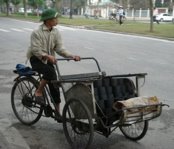 A driver with this kind of taxi might not have a lot of time for research or writing, but many drivers around are potential, active, or retired university students, researchers, professionals in various trades, writers, editors, translators, and so on.
So the Research Cooperative invites participation by taxi drivers who are looking for another kind of work to fill in time between customers, or for days off the road. At the same time, two complementary blog sites have been created:
- Cab Call Mobi (stories about using taxis), and
- Taxi Stand Mobi (practical information about taxi services)
Photo: Hanoi, 2006
Tuesday, October 03, 2006
Museums are not just archives
 SideLines, October 2006 (A cross-posting from New Zealand Science History) As in other countries, museums in New Zealand are not just archives or places for storing old things - they are also centres of research, and many are also historical centres of research. Many of the old things kept at museums are important records of early research in New Zealand (e.g. in collections of early letters, photographs, publications, plants, animals, rocks, and a huge range of cultural materials).
As venues for exhibition, museums are able to present the results of research in ways that are accessible for people from all areas of society. They are able to juxtapose old materials and new materials so that we can see how the world around us has been changing, over time.
Over the last hundred years or so, exhibitions have had an important role in the development of research in New Zealand. Research is never important in itself - it is only important if it it is effectively expressed in scientific journals, in newspapers or magazines, in school and university courses, in the continuous development of many different industries, and in exhibitions. Developng an exhibition can be a stimulus for new directions in research, as well as providing a venue for presenting the results of previous research.
At Auckland Museum, the representation of human scientific efforts extends to the 'prehistoric' period (before writing) - with a display showing how the earliest settlers from the tropical Pacific explored and came to understand the natural environment and resources that existed in temperate New Zealand.
Some of the the oldest museums in New Zealand are located in Auckland, Wellington, Whanganui, Christchurch, and Dunedin. Are there old museums in other places in New Zealand? Information from our readers would be welcome (plese click on the link for comments, below).
Photo: experimental toy canoe made from flax, as part of preparation for an exhibition on Vaka Moana (opening at Auckland Museum, December 2006)
Thursday, August 31, 2006
All may register
SideLines, September 2006
Actually, a spam attack on our forums has forced us to require that all forum contributors register.
So you may - and you must - register to post messages and replies in the Co-op forums. Registering is not difficult and is still free (use the Registration link in the main menu, near the top).
Reading and using information from the forums is completely open to everyone. Our aim has always been to communicate offers and requests - for language services, for research - as openly and widely as possible.
To express any opinion about this matter, please use our Viewpoints column (see the website), or contact Peter, c/o The Research Cooperative (NZ): pjm (at) gol (dot) com). Thank you!
Actually, a spam attack on our forums has forced us to require that all forum contributors register.
So you may - and you must - register to post messages and replies in the Co-op forums. Registering is not difficult and is still free (use the Registration link in the main menu, near the top).
Reading and using information from the forums is completely open to everyone. Our aim has always been to communicate offers and requests - for language services, for research - as openly and widely as possible.
To express any opinion about this matter, please use our Viewpoints column (see the website), or contact Peter, c/o The Research Cooperative (NZ): pjm (at) gol (dot) com). Thank you!
Subscribe to:
Posts (Atom)
